

Sign up for our free monthly news and story alerts |
ADVENTURE Escape into thin air: Why Ladakh will leave you breathlessOver 12,000ft up with yaks, yetis and bumped passengers. A Ladakh guide for the intrepid but, yes, with hot water and WiFi.   by Vijay Verghese updated by staff reporters SEE ALSO Andaman Islands | Bangalore guide | New Delhi business hotels | Delhi musings | Goa resorts | Gulmarg | India spas | Kerala resorts | Mumbai business hotels | Rajasthan palace hotels | Zanskar treks | Bhutan guide | Nepal treks | Kathmandu 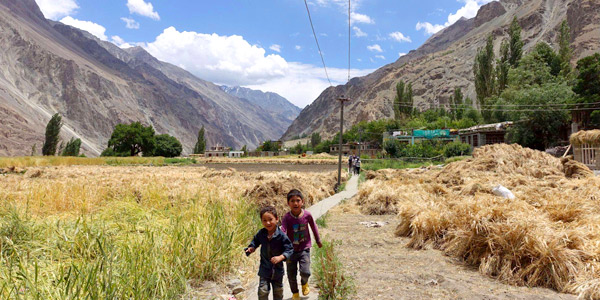
Ladakhi children scamper through the fields enjoying the summer respite not far from Leh which, at over 11,500ft, is only really accessible just a few months mid year/ photo: Dinesh Dayal JUMP TO Hiring taxis | Nubra tents, Thikse, Stok, Hemis, Alchi | Nimmu luxury, Leh hotels | Leh eats and pizza | Information, agents LADAKH WILL TAKE YOUR BREATH AWAY. At 12,000ft, the capital, Leh, is already higher than most Alpine mountaineers will have ventured. Mount Blanc is a trifling 15,771ft while in Ladakh roads soar to 18,340ft (Khardung-La pass) where you can have the highest kiss, toilet-trip, sneeze, cough, conversation or nervous breakdown of your entire life. 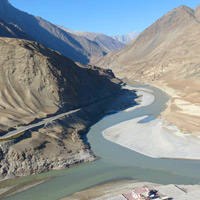
Looking at the confluence of the Indus and Zanskar Rivers/ photo: Yvonne Kwee Up here in the rarefied air of India's "Little Tibet", oxygen – and airline seats – are at a premium. Walk slowly and book early. I was pleased then to see my travel agent's itinerary. It was simple. Stay in bed for two days (to acclimatise) and then fly back to Delhi. This seemed like a good plan. Delhi has a lot more oxygen than Ladakh. Our return flight was waitlisted but the airline assured us we would be confirmed by the time our lungs had recovered sufficiently for us to make the journey from our hotel back to Leh airport.
Ladakh, when we arrived, was breathtaking, the mountain desert stretching from pinnacle to pinnacle, painted in stunning streaks of purple, brown and grey with slivers of startling, shaggy green along the mighty Indus. The blue of the Ladakhi sky is surreal, pure, the sort of colour that’s exceedingly hard to capture on a camera. This may be due to the excessive ultra violet light at this height. Or it might be due to the fact that any clicking of cameras at the airport will result in an international incident unless, like me, you carry an Indian passport in which case it would just be a lack-lustre domestic butt-kicking. Send us your Feedback / Letter to the Editor 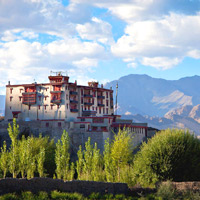
Stok Palace Heritage Hotel/ photo: hotel Photography is not permitted at the airport or on the one-hour flight from Delhi to Leh. This is for security reasons. Someone might discover those peaks marked in such detail on every school atlas, actually do exist. All batteries are scrutinised thoroughly as well. I wanted the security guard to examine my growing bald patch and confirm if it had indeed spread but he was not interested. I am all for security. In an age where satellites and iPhones can accurately count yak pubic hair, who needs amateur cameras? That said, it’s a snip to fly to Leh from New Delhi on Air India (www.airindia.com), Go-Air (www.goair.in), and Indigo (www.goindigo.in/). By 2018 premium airline Vistara (www.airvistara.com) was operating a daily Delhi-Leh flight as well. In summer of 2022 the round-trip fare on Vistara was just under Rs6,000 or about US$75. Travellers can fly from Srinagar, the capital of Kashmir too. To acclimatise, wash your socks and watch them dry. Or simply ask your mother-in-law to dry her fingers in that plug socket on the wall while you throw the switch. This is a serious issue. Start up too fast and you’ll have a weeklong hangover – or worse. First day, stay in bed and read. Drink lots of liquid. Second afternoon, venture into Leh town for a short stroll. Drink more liquid (not alcohol). By the third day you’ll be able to visit the toilet without staggering and blacking out. By the fourth day you’ll be fine. Lightening trips are out. 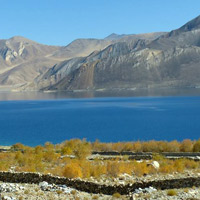
Looking across Pangong Lake towards China/ photo: Yvonne Kwee Take your time and spread out the journey. There’s much to explore. Summer daytime temperatures can warm up to the mid thirties (centigrade) though the shade is cool. Nights can drop to 10 degrees, especially after rainfall – or snow in the higher mountains. Rain is uncommon though and the air is exceptionally dry. Leh, where three empires once met, is a one-horse (or one yak) town with a distinct frontier taste, though this is rapidly changing. There’s dust, bleary eyed backpackers, honking jeeps, trinket sellers, hawk-eyed Kashmiri salesmen, grizzled sun-blackened Ladakhis spinning prayer wheels, local women in woollen gonchas (gowns) and peraks (the traditional headpiece with a dowry-load of turquoise) and frequent power cuts. That's when the diesel generators kick in and the smoke gets really intense, especially in the numerous hole-in-the-wall Internet cafes dotting the market. Web connections have improved vastly in recent years, but don't be surprised by patchy or slow service – at throwaway prices you can afford to be patient. You can talk to the outside world through the Internet and STD (State Trunk Dial) booths though mobile phones are problematic and in most instances will not work. Local pre-paid SIM cards may be available. On much of the road journey between Manali and Leh and Srinagar and Leh - in fact outside any major town like Leh - there is no network unless you are carrying a satellite phone. Don't expect 3G networks and for the most part you'll find patchy 2G. There are some satellite phone stations for emergencies. What this boils down to is prior planning, a great deal of it. You will not be able to hook up casually with your date after being separated at Hemis. 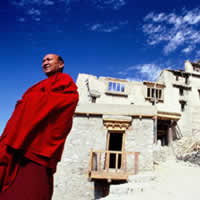
Monk outside Leh Palace/ photo: Vijay Verghese The exchange rate is roughly US$1 = Rs79. The market hosts a State Bank of India branch with an ATM and moneychangers. Also spot an ICICI Bank with ATMs and JK Bank ATMs. Cash-dispensers are not at every street corner and you'll need to hike across town to find a machine. Credit cards are not big in Ladakh and it is wise to bring rupees with you from Delhi, in small denominations. If you are at a loss for what to do or need more local information, stop by the the Tourist Reception Centre (tel: [91-1982] 252-094) and pick up useful information from the official Leh website. Thirty years ago Leh was just two intersecting streets and a polo ground. Now it has a bit of Kathmandu kitsch about it. I’m not entirely sure this is a good thing but the economy is booming and foreign “pollution” is kept to a minimum with the snows closing the passes six months of winter when the place goes into hibernation and people wish they were eating hot kebabs in Delhi rather than heating pipes to get some running water for a cold bath. Plastic bags are banned throughout the region to preserve the fragile ecosystem. Any litter must be properly disposed of. Still, the Buddhist influence is ubiquitous like a calming stomach tonic and some gomphas (monasteries) are simply stunning. Leh Palace, a small replica of the Potala Palace in Lhasa, is a brief climb up from the city with exhilarating views. How to arrange a fixed-rate taxi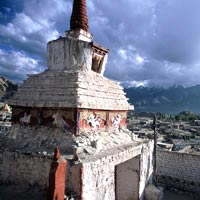
Chorten above Leh/ photo: Vijay Verghese Once acclimatised, hire a car from the Ladakh taxi union (tel: [91-1982] 252-723/ 256-086) that offers fixed-price car-with-driver hires for all destinations. Their website is detailed and well presented with rates and a sightseeing gallery. Opt for the comfy Innova, a TATA Sumo or a Scorpio. Bouncy small cars are just about okay, if not for pampered bottoms, but tiny vans will be testing on potholed roads. Try a quick trip along the river to Thikse monastery, one of the loveliest, a half-day tour east to the frescoes of Alchi monastery (passing the majestic Zanskar and Indus River confluence), or a fast drive up to Khardung-La (Rs2,890 return), the highest motorable road in the world just 39km from Leh. Khardung-La leads on to the virgin (and very restricted) Nubra Valley (Rs12,500 over two days, return) where grey double humped Bactrian camels roam free searching the classifieds for harmonica-playing Marlboro ponies. An Inner Line Permit (www.lahdclehpermit.in/) is required for several areas but freer access for Indian passport holders is being expanded and issuance is online. International travellers should look at a Protected Area Permit (available on the same site). The wild horse herds, antelopes and yaks are harder to spot these days but are usually found at higher altitudes in remote inner Himalayan valleys. Some more Ladakh taxi rates for sightseeing and longer trips. A Leh wander is around Rs2,500 depending on how far you wish to stretch it, and a two-day return journey to the turquoise mirror-smooth Pangong Tso (lake) bordering China is upwards of Rs10,200. The two-day ride Srinagar Leh costs Rs18,400 while a similar duration Leh-Manali run is priced over Rs21,500. One-way runs to or from the airport are about Rs500. And for fun, capitalising on the movie, there is even a 3 Idiots circuit. All prices are fixed annually by the taxi union. Nubra tents, Thikse, Hemis, Stok, Alchi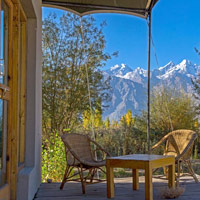
Great views from Nubra Ecolodge/ photo: hotel Out in the northern Nubra Valley wilds check out the charming and comfortable tented Nubra Ecolodge (www.nubraecolodge.com/) with timbered patios offering grand views of snow-capped peaks and, importantly, en suite bathrooms. Apart from safari-style tents there are a couple of guest rooms and two cottages (with a false ceiling and stretched canvas roofing). Look forward to bracing walks, organic food, and WiFi. Another option is the Lharimo North, Nubra (lharimo-north-cottage.business.site/), in Tergar Village with 22 cottages with en suite bathrooms and hot water. Hurrah! Lharimo runs a popular spot in Leh as well. Chamba Camp Diskit (www.tutc.com) operates comfy tents usually 15 May to 30 September in Nubra Valley. Expect a roomy canvas space with comfortable memory-foam beds, writing desks with phones, mini-bar, and en suite bathrooms (yes with a hairdryer). Finally, the Lchang Nang Retreat (lchangnang.com/) is a romantic pick with 17 white-plaster Ladakhi stone-and-wood cottages, all with private patios and sublime mountain views, with the Siachen River murmuring past the western end of the retreat. The camp is in an apricot and apple grove. Back south in the Indus Valley and not far from Leh, Thikse is one of the best-preserved and most colourful monasteries, built in the traditional piled-up pyramid above the town. As was the custom, it is a mini-Potala. Catch your breath and climb up to the top to view the large Maitreya (future) Buddha. 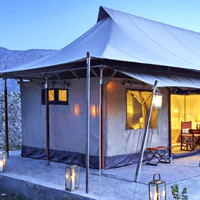
Tent at Chamba Camp Diskit, Nubra Valley/ photo: hotel Ladakh is a land of wonderfully mechanised religion and this is evident along the approach. Colourful prayer flags and spinning prayer wheels (driven by hand, wind and water) scatter their inscribed hymns, blessings, and entreaties skywards (or downriver) ensuring communication with the Gods is always open. Travellers will also encounter mani walls, mounds constructed with flat, smooth mani stones with the inscription "Om mani padme hum" (Oh thou jewel in the lotus). When approaching Mani walls and prayer wheels, keep them to your right. These sacred walls are usually preceded by small shrines called chortens. The Thikse festival is in late September. Chamba Camp Thikse (www.tutc.com) has a magnificent view of the monastery from Thikse village with accommodation in luxury tents littered with Raj relics for nostalgia buffs. There is an inhouse bakery, a library, and a WiFi zone so you can stream your Instagram feed whenever the connection is stable. A further 45-minute drive south from Thikse will bring you to Hemis, one of the oldest and most revered monasteries. It is not the prettiest by any stretch but has earned acclaim largely on account of the fact that its annual festivals and colourful dance dramas (cham dances) run in summer, coinciding with the tourist season. Most other festivals run in winter. There is also a super festival every 12 years when a giant tangkha (Buddha image embroidered on silk) is brought out for public viewing. 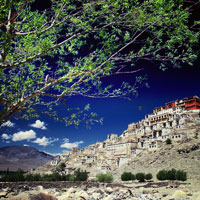
Thikse Monastery is a gem, and very accessible/ photo: Vijay Verghese On the same road, closer to Leh, are Shey (with its palace where all royal children are born) and Stok, where part of the royal palace has been converted into the Stok Palace Museum. Shey was the former capital of Ladakh. Also possible are stays at the Stok Palace Heritage Hotel (www.stokpalaceheritage.com/) with balconies overlooking the sweep of the Indus. Expect bright mustard-and-green-hued woody rooms with log beams holding up the ceiling, Ladakhi motifs in red and lapis lazuli, rugs, and woodcarvings, along with parquet flooring and good bathrooms. Of course there is a plus side to living in a museum. Check out intricate tankhas (Tibetan paintings on vast cloth scrolls) armour and more. Or opt for the hotel's Heritage Villas set in apricot groves where blossoms errupt in April. WoodyVu Stok House (on Facebook ) offers a contemporary setting in a beautifully renovated Ladakhi ancestral home that has been with the Lhoskya family for a century. Rooms are smart, if minimal, with grand views all around. Yes, there's hot water and WiFi. It is a perfect spot to enjoy nature with few distractions in the vicinity. The hotel candidly cautions guests: "Please do not expect a hundred percent perfect WiFi... Winters here are harsh, dry, severe and sometimes unimaginable." Heading east from Leh takes you along the roof of the world under a Big Sky to Alchi and Lamayuru. The somewhat inaccessible Lamayuru is a rewarding site though it is a good two hour drive from Leh. Alchi, which dates back to the 11th Century, is a collection of small temples with elaborate frescoes. The village is clean and pretty with some nice guesthouses and restaurants. 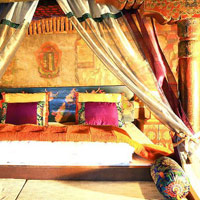
Stok Palace Heritage Hotel offers an authentic ambience/ photo: hotel Try the simple and clean Potala Hotel Alchi (www.facebook.com) or the modestly larger Alchi Resort (alchiresort.com/). The drive is stunning, along a high plateau, through deep gorges and mountain desert, past serrated ridges with red and purple striations, along the deep furrow of the chocolate Indus. There is a Magnetic Hills site along the way where tradition has it cars stall on account of the “force”. En route, drop by Likir monastery and, just outside Leh, the colourful and well preserved Spituk gompha. Nimmu luxury and Leh hotelsIn the midst of this beautiful desolation lies Nimmu, a small verdant oasis with whispering barley fields and proud white chortens where children sell sweet miniature apricots. Nimmu is also the hopping-off point for the 22km white-water run down the freezing Indus. The half-day trip starts at Phey, just outside Leh. Several agents sell this package. The river starts off deceptively slow and then speeds up in the narrows as the meltwater builds up. The rapids are classified as Category 3 but are gentle enough for the family. Some days are rougher than others. It can get hot – and wet – so carry a change (in the van) and dress lightly. Quick-dry rubber footwear of some sort is advisable especially if you are prone to tumbles. Barefoot and freezing I concentrated on the rough-hewn grandeur around us while my teenage son concentrated on his chapped lips. Later at the hotel we continued to bond, he with his MP3 music player and me, horizontal, with my bed. Don’t underestimate the altitude, ever. The best bucolic boutique stay option in Nimmu is the highly regarded Nimmu House (ladakh.nimmu-house.com/) with four spacious bedrooms in a preserved Ladakhi manor dating back a century - commissioned for a cousin of the king - as well as seven deluxe tents. Think stone courtyards, orchards, and wandering shaggy yaks and dzos. 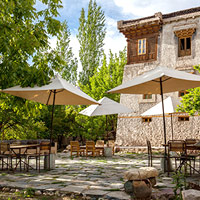
Ladakh manor born - Nimmu House is a splendid retreat/ photo: hotel While not ornate or heavy on trimmings, by Ladakh standards this is a luxury retreat and will set you back around US$200 in the summer high season. While you can certainly get cheaper digs in Leh, this is worth the spend to savour the countryside. Farther away and much higher lie the beautiful salt lakes of Pangong (13,930ft above sea level) and Tsomoriri (14,000ft above sea level and 240km from Leh) Both will require an overnight stay and "restricted area" innerline permit. Make multiple photocopies of your passport and permit before you go. There are several security checkpoints on the way that may ask for them. The tourist season runs from May to October but really peaks in July and August. Leh hotel rooms, like airline seats, are in short supply. Some good choices in the A Class range (there are no star ratings here, Class A is the equivalent of a 3-star hotel) include the secluded and friendly Shambha-La, on the fringe of town in a poplar grove, Kanglhachen and Lharimo (both close to the market), and the cheerful good value Hotel Bijoo (tel: [91-1982] 252-131). Class A hotel rooms in general tend to be decent with twin beds, small cable TVs, intercom phones, attached bathrooms with hot water at scheduled times, candles and matches (although electricity has improved, and hotels normally have backup generators), travel desks, ISD/STD (state and international dialing) facilities and sometimes Internet or a WiFi room. Hotel design is traditional two-storey Ladakhi with white hand-plastered walls and blood-red doors through which from time to time emerge bleary-eyed travellers, seemingly blotto, to upchuck, squint or pass out. 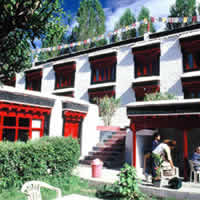
Lharimo Hotel close to town/ photo: Vijay Verghese The charming Shambha-La (www.hotelshambhala.com/) is the quietest of the lot with a comfortable sunny lawn with hammocks and cushioned chairs. Food and service are normally good though the hotel has certainly seen better years in the past. Set away from the main road it is free of automobile fumes and dust. Lie back in the garden, listen to the chimes, unwind and watch the poplars shed their silvery cotton fluff. Check e-mails on WiFi, or read a book from the library while you wait for the laundry service to return your clothes. The Lharimo (or Lah-Ri-Mo as it is also spelled) is a very good spot, closer to town, bright and clean. It is popular with couples, backpackers and trekking groups. Expect private bathrooms with hot water and showers. This group also runs the Lharimo Retreat a few kilometres out of Leh and the Lharimo North, Nubra (a lovely cottage in Tegar Village). The top-end Kanglhachen (or Kang Lha Chen, www.hotelkanglhachen.com/) runs a more than decent kitchen and is well located right above the main market area. It boasts a few travel agencies on its complex for all your adventure needs. Expect more solid hotel-style rooms with wooden floors, comfy beds, attached bathrooms with solar-heated water, LCD televisions with satellite channels and Internet access. The Druk Ladakh (www.thedrukladakh.com/) serves up hotel-style rooms with LCD televisions, teak furniture, wooden floors, and Internet access. Another Leh option for those in need of a few creature comforts is The Zen Ladakh (www.thezenladakh.com) with neat gardens, clipped hedges, a small fitness centre and swimming pool (both something of a luxury in Ladakh), a conference space for 50 persons, and rooms with ensuite bathrooms, tea facilities, flat-screen TV and WiFi. 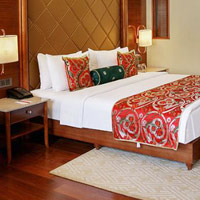
Grand Dragon is plush by Leh standards / photo: hotel If you want something substantially luxurious - to rise above the toil and grind of the Great Outdoors - and are prepared to shell out for the privilege, try the Grand Dragon Ladakh Hotel (www.thegranddragonladakh.com/). One of the better four-star hotels in Ladakh, it features a well designed complex with outdoor gardens, swanky modern interiors with contemporary furnishings, flatscreen TVs, gleaming wooden floors, working desks, lamps, WiFi Internet access, showers, and views. The south side faces the snowcapped Stok mountains while to the north, rooms overlook Leh Palace in the direction of Khardung La Pass. They even have humungous Premier Executive Suites available, which include a master bedroom, a sitting room and two attached bathrooms. The hotel is proud of its eco-friendly design, with hot water and central heating supplied by solar panels, and double glazed windows to decrease electricity needs – handy, as electricity supply in Leh is volatile. Open year round, it offers white water rafting during the summer and, if you’re brave enough, ice hockey in the winter. Prices are steeper compared to the regular Leh offerings, but the quality of service and comfort it provides merits giving it some thought. And if you need 2,000sq ft of space for a small meeting or exotic company conference, the hotel has that too. Tucked away in green fields, the family-run Padma Guest House & Hotel (www.padmaladakh.net/) with its organic vegetable and flower garden and unobstructed views of snow-clad peaks is an excellent budget alternative. The crisp and clean upgraded hotel started at Rs2,800 (May 2018) for just the room without breakfast. The newer rooms are more than adequate with decent toilets. The Padma also has a meditation room and, wait for it, free WiFi and Broadband access for guests. Another attraction is the solar heated running hot water. Try and bag corner room 107. 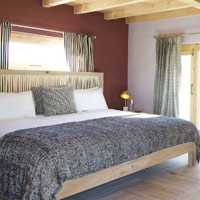
Rustic chic Shakti Ladakh is actually a collection of spread-out cottages/ photo: hotel From Shakti Ladakh (www.shaktihimalaya.com) a set of six village houses, one dating back 200 years (though the plumbing has been modified in recent years), open from May to late September when the weather is accommodating and the daytime crisp with clear skies and bright sunshine. Expect invigorating walks, hikes, rafting and close-up encounters with nature at 11,000ft. Return to a simple whitewashed courtyard setting with darkly regal rooms featuring rough-hewn timber floors, crazy-angle wooden tree columns holding up the creaking roof beams, heating samovar for chilly nights, and dark fabric sofas with fuchsia cushions. It is a wonderfully stark yet rich setting with none of that modern chi-chi humbug. This is pure Ladakh. Mark it down in your diary. The cottages are in various locations about 20 minutes from each other a little south of Leh on the Thiksey road. Children are welcome but only if they are over seven years old. The distinctive Mongolian yurt tents of Ladakh Sarai (www.ladakhsarai.com/) at Saboo Village seven kilometres from Leh are a signature offering, now accompanied by a tad more modern six-hut Mud House in quintessential Ladakhi style with attached bathroom and LCD television, a new low-slung Duplex building with outstanding views, and a Chalet with five rooms and white-wood carved balconies. 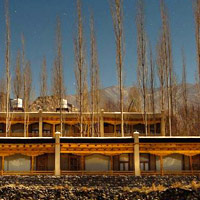
Duplex building at Ladakh Sarai, better known for its tented yurts/ photo: hotel There is an older Heritage Wing as well with three rooms. This is an eco-friendly retreat with homegrown organic vegetables and solar-heated water. Expect great food and top-notch service. Hike, trek, play pool, or contort in the yoga room. At the other end of the price scale, a good hunting ground for guesthouses is along the quiet, Changspa Road above the market leading to Omasila and beyond. The Silver Cloud Guest House (silvercloudguesthouse.blogspot.hk/) near Sankar Village is basic and bright. Everywhere meals and hot water run at designated times, so note it down. Tea, however, is abundant. Decorum is strictly observed and all main meals are usually preceded by soup. If you are up to it, try the local gur-gur chai, a yak butter-and-tea concoction that will have you racing for the toilet in no time. Attempt this only after you have acclimatised or the outcome may leave you gasping for more than one reason. If you are feeling poorly, many hotels have doctors on call for their guests. Watch some cable (or satellite) TV while you recover. If you are lucky enough to have a phone, call up some room service. There are limited numbers of phones and TVs in many hotels. 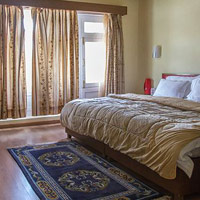
Kanglhachen above the main market is a hotel in a city sense/ photo: hotel Spic-n-Span (www.spicnspanladakh.com/) is an upgraded three-storey grey-stone address with white-wood trim, wrap-around balconies, elaborate wooden railings, wooden floors and rugs in the 33 rooms. Very Kashmiri. The toilets have SHOWER CURTAINS, a genuine Leh luxury. Its central gas heating enables it to run through the coldest winters and WiFi is free (but subject to availability). A suite her may set you back around US$140. So you would not be surprised to also get a small sunny garden, a coffee shop, a business centre, and cultural shows. For Bollywood fans, Hotel Omasila (www.hotelomasila.com/) is a good bet. The view is fantastic, but that’s not the only sightseeing to be done, as Omasila is famed for its celebrity guests who might break into a bosomy shimmying dance routine at any time. Find LCD satellite TVs and none too pinching rates from around US$55. Other options include the modern but banal Hotel Singge Palace (www.singgepalace.com/), the comfortable family-run Mandala (www.mandalahotel.in/) with brightly coloured linen, work desks and French windows, the Lasermo Hotel (www.facebook.com) and the simple and laid back small grey-stone and brick K-Sar (www.facebook.com/ksarhouse/) guesthouse. The Hotel Lumbini (tel: [91-1982] 252-528) is okay but its rooms are facing the road and the garden is protected when it should really have been the other way around. 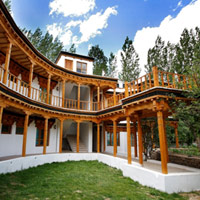
Lharisa is an eco-friendly boutique hotel/ photo: hotel Despite this, it is a popular choice for many and peak season rates can climb to US$70 for what are very simple rooms. A kilometre away from town, the Cho Palace (www.chopalace.com/) offers some quiet rest and relaxation. Also, Lharisa Resorts (www.ladakh-lharisa.com/) offers an eco-friendly boutique complex with private terraces and gardens for each room. Backed by the ITC Hotels WelcomHeritage marque, service is less variable and the product follows a brand standard (that even by Leh standards, adds a modest boost). Leh momos, bites and, yes, pizzaLeh town also offers pizza, on the roof and Indian food. Check out The Nook, which pulls in satisfied chompers for a bit of everything and if you really must, there's a Pizza Hut in the main market. Oh dear, did we really say that? Good pasta choices include La-Terrasse (nice views, lousy dungeon toilets), La Piazzetta and La Pizzeria. Tibetan food is best sampled at Tibetan Kitchen (www.facebook.com) that has been long established with great flavours and an alfresco dining area, Summer Harvest (everything from momos - dumplings - to lasagna) and Amdo Restaurant (for cheaper nosh). Painted paper umbrellas and ornate fans create a cosy yet funky vibe at Chopsticks Noodle Bar, which serves everything from momos and satay to spicy Szechuan noodles. And for those missing simple Western food, the Pumpernickel German Bakery (www.facebook.com) offers fresh homemade baked goods and sandwiches. 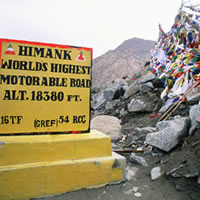
Khardung-La, the highest road anywhere/ photo: Vijay Verghese Whatever you want to do, just say, "Julley" (pronounced joo-lay), the versatile Ladakhi greeting that means everything from "Hello," and "Goodbye", to "Shucks! My mother-in-law has no oxygen and no hot water, but she's still breathing." Holiday over, my teenage son and I headed to the airport. In a wonderful display of hospitality, the airline had not yet confirmed our seats, hoping we might enjoy Ladakh a bit longer. We did. For three more days. I finally threatened to photograph every square inch of the airport. Something worked. And on the seventh day we rested, in Delhi. Julley. Send us your Feedback / Letter to the Editor FAST FACTSPrices and contact details for Ladakh hotels are notoriously hard to pin down and they change often. Websites and e-mail may often not work at all. Hotels are closed during the winter months and resume operation in summer with the advent of the tourist season. In general expect room rates ranging from US$45 for a tented eco lodge in Nubra, or US$80 for a decent double room in Alchi, to US$90-$100 for a mid-range three or four-star address in Leh, with high end Leh hotel room rates at US$120-$150 and up. 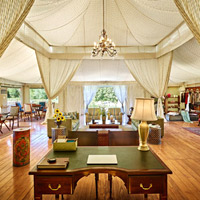
Chamba Camp Thikse, luxury tents - reception area / photo: hotel The exchange rate was around US$1= Rs79 summer 2022. Bring small denomination Indian rupees with you if possible. Credit cards are not customarily used in Ladakh, although some hotels do accept them. There are a few moneychangers in the market and some bigger banks. It is customary to tip people who help you: tour guides, waiters, porters, and drivers. Check out the useful site www.reachladakh.com. Another useful resource that promotes a harmonious eco-friendly tourism approach, is Ladakh Ecological Footprint at www.ecologicalfootprint.in. The company also arranges trekking, mountaineering, rafting, kayaking, wild life photography, mountain biking and a Ladakh Volunteer Farm Project. Contact Stanzin (stanzin@ecologicalfootprint.in) for more information. Travel Agents LehLadakh Ecological Footprint. www.ecologicalfootprint.in Travel Agents New DelhiEco Adventures Pvt Ltd. www.magical-india.com
NOTE: Telephone and fax numbers, e-mails, website addresses, rates and other details may change or get dated. Please check with your dealer/agent/service-provider or directly with the parties concerned. SmartTravel Asia accepts no responsibility for any inadvertent inaccuracies in this article. Links to websites are provided for the viewer's convenience. SmartTravel Asia accepts no responsibility for content on linked websites or any viruses or malicious programs that may reside therein. Linked website content is neither vetted nor endorsed by SmartTravelAsia. Please read our Terms & Conditions. |