
Sign up for our free monthly news and story alerts |
CITY GUIDE Kathmandu: a mystic Wild West with comfortable bedsA Kathmandu fun guide for the intrepid. Yaks but no yetis, steaming momos, mystic temples - being laboriously restored - and our pick of top beds for business or leisure as new brands like Dusit arrive in 2023.   Updated by Ed Peters with original reporting by Jane McLean SEE ALSO Nepal Treks | Andaman Islands | New Delhi Business Hotels | Goa Resorts | Himachal | Ladakh Guide | Mumbai Guide | Rajasthan Palace Hotels | India Spas review | Bhutan fun Guide | Delhi Guesthouse reviews 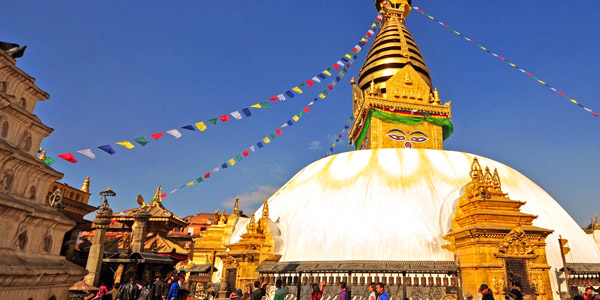
The all-seeing eyes atop Swayambhunath stupa survey the old quarter as well as Kathmandu from a small hill about four kilometres out of town/ photo: Discover Nepal JUMP TO Getting around | Sightseeing | Shopping in Kathmandu | Hotels and casino | Budget hotels | Dining and restaurants | Hotel Contacts NEPAL has had a rough ride so far this century. A royal massacre, a civil war, a devastating earthquake, and a blockade on the Indian border that sent prices soaring in a country that was already having trouble making ends meet. 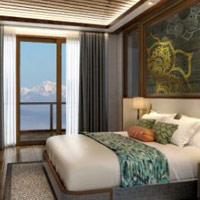
Dusit Thani Himalayan Resort Dhulikhel Nepal arrived July 2023 / photo: hotel Not quite the headlines to excite traveller wanderlust. But with peace restored, pivotal countrywide December 2017 elections that produced a left-leaning government, relations on the mend in the south, and rebuilding underway, it's time for a fresh look. Travellers will not be disappointed. What’s the big deal about Nepal? Well, for one, it’s home to that great hulking 8,850-metre (29,035ft) beast of a mountain, Everest, or Sagarmatha or Chomolungma (Holy Mother), not to mention seven more of the world’s 14 highest peaks, several of them over the magic 8,000m mark. Mt Everest was awarded seven extra feet in height following a detailed geological survey, involving placement of a GPS system on the peak. For the world’s mountaineers, Nepal is a veritable playground. And, yes, any Nepal guide will be stacked with adrenaline-pumping things to do like weaving around mountains in a sightseeing plane, hiking up to breathless heights, ripping down rapids in a raft, kayaking, canyoning, mountain biking and paragliding.
But it’s not only adventurers who will be happy campers in this landlocked nation. Nepal has a heady mix of religion, culture and architecture; more than enough to satisfy any curious soul. And you don’t even need to step foot outside the capital, Kathmandu. City of the gods, valley of temples, a living museum; call it what you will, but one thing is for sure. Visitors won’t be disappointed. Enjoy street life, shopping, hundreds of shrines and temples, and grand views of the surrounding peaks. Pack sturdy walking shoes, grab a camera and venture forth. Send us your Feedback / Letter to the Editor 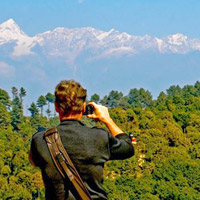
Mountain views from Nagarkot / photo: Discover Nepal Politics, always heady, remains in flux, with the erstwhile Maoist guerrillas dropping their guns in favour of elected office and the more sedate corridors of government. The Maoists swept to power in April 2008 following elections on a platform of change and the elimination of the monarchy. Despite sporadic street protests and an end to the Maoist government honeymoon by May 2009 and frequent upsets since, the election of the Nepali Congress (the country’s oldest political party) in late 2013 gave the Nepal Tourism Board (www.welcomenepal.com) something to finally smile about, as did the acceptance of a new constitution, another stabilising factor. The subsequent earthquake in 2015 was a major setback, destroying hundreds of buildings and killing an estimated 9,000 people – but Nepal is getting back on its feet, if slowly. To fund rebuilding work, many historical sites levy an entry fee, with the amount varying by nationality. Restoration work though has come in for some criticism (contracts are awarded to the lowest - rather than the most experienced - bidders), even drawing protest from UNESCO, which feels substandard repairs could threaten the heritage status of some ancient sites. Still, best foot forward and on with our Kathmandu fun guide for the intrepid. Most visitors to Nepal tend to mix up their stay with a few days in Kathmandu and a trip perhaps to Pokhara, the Annapurna Circuit, Lumbini (the birthplace of Buddha), Sagarmatha (Everest) or Chitwan National Park. Kathmandu is a transit hub. But the city is a destination in itself. The Kathmandu Valley is an extraordinary feast, boasting seven cultural world heritage sites and a lot more in between. In the valley it’s said there are more temples than houses, more gods than people, and a festival 365 days of the year. The best known face of religion here is probably the Kumari, or Living Goddess, a child deity symbolising perfection and innocence. The most recent incarnation was anointed in September 2017. 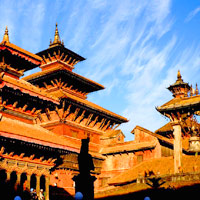
The old city architecture in the right light is stunning There are indeed a staggering number of temples, shrines, pagodas, stupas – so many that you could walk the same streets for days and notice something different every time. And it’s not only the architecture, but the sights, the smells, the sounds that reveal the true spirit of this city. People are warm and welcoming. Monkeys and cows amble about temples, women in bright sarees haul mounds of straw up hillsides, Hindu funerals take place on the river, and kids haul up buckets of water from deep wells. Traffic grinds through jam-packed streets: motorcycles, scooters and smoke-belching trucks, all battle for space. Urbanisation and overpopulation have highlighted issues like air pollution, water shortage, poverty and hygiene. Heritage conservation appears to be less of a priority in the face of recent development. But that has not changed the essence of the city – yet. Some hotels and restaurants are making a concerted effort with sustainability and conservation efforts. Airport and getting aroundKathmandu’s mildly chaotic Tribhuvan International Airport is a blend of brick and a bit of glass. It was virtually empty on the night I arrived save for a few immigration officers who manned tiny desks piled high with paper. Renovations to the airport are ongoing. Plans are always mysteriously afoot to expand. In the meantime, maintain a firm grip of your bags and your patience. All visitors to Nepal, apart from Indian nationals, need a visa to enter. If you haven’t already got one, you’ll need to fill out a brief form and hand over your passport, a passport photo and pick which visa you need. A 15-day visa costs US$25, while US$40 gets you a 30-day visa and one for 90 days is around US$100. It doesn’t take long, but the time depends on the length of the queue. Free visas are given to nationals of SAARC countries (South Asian Association for Regional Cooperation). There is no charge for children under 10 years old. 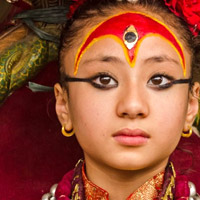
The divine child, Kumari / photo: Discover Nepal The Department of Immigration in Kalikasthan in Kathmandu will extend visas for 30 days for US$30. When travelling to and from Nepal make sure to reconfirm flights. Most of the big hotels have a travel desk and will do the reconfirmation for you. There is no departure tax when leaving the country. Walking out of the airport is an exercise in blocking the ears (there are swarms of people hollering at the exit) and opening your eyes, (you’ll be looking for a taxi or a sign with your name on it). To save the hassle of negotiating taxi fares, organise transfers with a hotel beforehand. It’s the smoothest way in. The best cab option is a fixed-rate taxi run by the whimsically named Airport Queue Taxi Service, found right outside the arrivals hall. There are metered taxis too but you may need to still negotiate a rate before you get in. The airport is located east of the city about eight kilometres from the centre and a taxi should cost about 300-500 Nepalese rupees (US$1=NRs131). That should be enough to get you to most hotels in Kathmandu. Sightseeing in the valleyA few of Kathmandu’s must-sees are within easy reach. Taxis can be hired for the day, or cars (with a driver) can be organised by hotels for however long you wish. Some taxis have meters, but I never found a driver prepared to use one. Paying 60 percent of the initial asking price is haggling’s rule-of-thumb. Traffic may be manic during rush hour, and the potholes seem to grow overnight. Cycles can be hired in a number of outlets in Thamel and prices start from around 200 rupees per day, but it’s a hazardous pastime given the traffic. Otherwise you could rent a motorbike to explore the Kathmandu Valley (at your peril) but do check your insurance coverage. Daily rates from US$45. Try www.bikemandu.com or www.bsmotorbike.com. 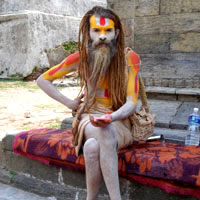
Sadhu strikes a pose for tourists/ photo: Jane McLean Kathmandu Valley was once occupied by three different kingdoms that have left their imprint in three main cities surrounded by mountains. Kathmandu is the capital and the biggest of this historic urban confection. At the centre sits the former Narayanhiti Royal Palace, which was until recently the sizeable (30 hectare) pink residence of King Gyanendra, now turned into a museum. Patan, south of Kathmandu, is the oldest city in the valley, founded in the third century BC. It was here that the Newari brick-and-wood style of architecture originated. There are more than 55 major temples in Patan all built around a grand total of 136 courtyards. It all makes for an impressive picture. And it’s as much an architectural wonder as a bustling place where you can sit and watch the world go by for hours. Like many of Kathmandu’s historic sites, Patan was hit hard in the 2015 earthquake: restoration work proceeds surely but slowly. The third city of Bhaktapur, known as the ‘City of Devotees’, is 14km east of Kathmandu. Entry costs NRs1,500. Traditionally, this area was home to mostly farmers. Bhaktapur has preserved much of its original structure, although many of the more decorated shrines were destroyed in an earthquake that hit the city in 1934, and again in 2015. In comparison to Patan, the temples are less intricate, the carving more sparse, but Bhaktapur is a huge attraction nonetheless. Each of the three cities has a central palace or ‘Durbar’ Square, where the original palace was located. Every Kathmandu guide will exhort you to head for Pashupatinath Temple, to the northeast of the city, considered one of the holiest sites for Hindus in Nepal. It is a UNESCO world heritage site and the pagoda is topped by a two tiered golden roof. Peak prayer times can get busy. 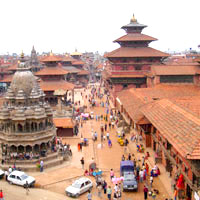
Patan temples remain an impressive sight, though restoration work continues/ photo: Jane McLean The crowds start streaming in from 4am until 7am and from about 5pm to 7pm. On the many important days in the Hindu calendar, like Shivaratri in March, you’ll be hard-pressed to take a step anywhere near the temple as pilgrims flock to the area. Visit around 11am on a normal day and there’s much to see. Only Hindus are allowed inside the temple itself, but visitors can wander the grounds for NRs1,000. Some years ago, the temple was hemmed in by residential houses, but they’ve since been razed and the land dedicated to Shiva Market stalls sell prayer beads and flowers, and saree-clad women wander among bored-looking cows and restless monkeys. The animals are fairly harmless though monkeys may take affront at snapping cameras and jutting lenses. Sadhus, or Hindu holy men, sit contemplatively on steps behind the temple, clothed in loincloths, adorned with white, red and yellow paint. Ragged children will pester you for handouts. Behind the temple is Bagmati River, a garbage-tip of muddy water. It is here that Hindu cremations are held. The former Royal Palace is smack bang in the middle of the city on Durbar Marg and is a good place to get your bearings. In May 2009, the palace opened as a museum to strong public interest. Durbar Marg is one of the main tourist drags in Kathmandu’s centre. Some of the more expensive shops, boutiques and restaurants are located on this stretch along with travel agents, coffee shops, bakeries and hotels. On a hill about four kilometres from Kathmandu centre is the Buddhist Swayambhunath Stupa, also known as Monkey Temple. The place, unsurprisingly, is swarming with monkeys. This stunning stupa is typical of many others you’ll see throughout the city though on a much larger scale with a broad white dome, gilt spire and prayer flags fluttering in the breeze. 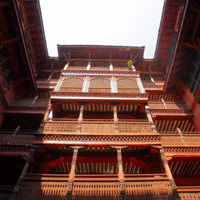
Intricate carvings viewed from Kantipur Temple House courtyard/ photo: hotel You’ll need to pay NRs200 for the pleasure of seeing it close up. Steps – 360 of them – lead up to the main part of the temple. Just below the spire, the painted eyes of the Buddha Vairochana look out in all four directions. Apart from the charms of the temple, there is the view looking out over the whole valley. This is an excellent perch for a memorable sunset. Boudhanath is the biggest Buddhist stupa in Nepal and is a Kathmandu landmark, which requires a NRs400 entry fee to view up close. It’s believed to have been built in 5AD. At the ground level are prayer wheels that release a mantra as they are spun. Rising from the centre is the spire (or harmika) with the all-seeing eyes on four sides. Surrounding the temple is a circular pedestrian lane with shops and restaurants. It’s a peaceful area for a quiet bit of contemplation. Badly cracked in the 2015 quake, it was dismantled and re-erected in record time thanks to an influx of donations from Buddhists around the world. Patan, also known as Lalitpur, is old. Very old. It’s a maze of little lanes, bustling streets and ancient architecture. Most of the monuments in the main square date back from the 16th century. SAARC nationals pay NRs20 while others must cough up NRs50 to view the Patan Golden Temple, which was built in the 12th century and is now a UNESCO world heritage site. Despite the effects of the earthquake, Durbar Square in the centre of Patan is a great place for people-watching and market action. Choose one of the walk-up six-storey restaurants, order a coffee and sit on the rooftop. One of the hundreds of festivals could conveniently be in full throttle. Thamel is backpacker central and, some say, the heart and soul of Kathmandu. A startling initiative to pedestrianize its main drag for much of the day kicked off remarkably well in October 2017; hotel trolleys tote guests’ luggage, and everyone can meander without the threat of being steamrolled by a motorbike or some wayward contraption on wheels. 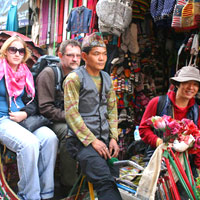
Thamel sightseeing by rickshaw with Viator/ photo: Viator Otherwise, drumbeats emanate from pubs, live music belts out from cafes, shoppers haggle, and, everywhere, are cheap guesthouses, shops, stalls and restaurants. This is the place for Kathmandu budget hotels and rock-bottom prices. In Thamel you might get flustered, but you won’t get bored. You can also change money, surf the Internet, drink yourself stupid, book a trek, get a tattoo, get a massage, get pierced, and generally, get exhausted. WiFi is ubiquitous, and there are numerous ATMs. The dance bars which open in the evening are generally regarded as clip joints and a cultural experience well worth avoiding. For a moment or more of calm, drop by the Garden of Dreams (entry NRs200) on Tridevi Marg, Kathmandu’s loveliest open space. Northeast of Kathmandu, about an hour’s drive over potholed roads and up a steep winding hill, is Nagarkot, 2,175m above sea level. Tiny wooden shacks selling tea (as well as local beer) dot the hillside going up and as the road climbs ever higher, the treat of a view just gets better and better. Stretched out before your gob-smacked eyes is a blanket of grass and farmland, wheat and rice paddies, the sprawling cityscape of Kathmandu and mountains by the mile. Nagarkot is a popular place for couples as well as potential couples so if you’re looking to woo someone, this is the place to begin. On weekends and public holidays, the roads and teahouses can be busy. There are places to stay and a whole lot to do, especially if you’re into nature. Mountain bike up to Nagarkot if you must, but watch for cars, trucks. The walks around the area are not too taxing. Finally, companies like Social Tours have proved a welcome development for visitors, running Nepali cooking classes or laying on a lunch with Buddhist nuns. Other options include weaving your own souvenir, or painting a thanka, all under the eye of expert artisans. The emphasis is on experience rather than just gawping and the company’s getting a highly enthusiastic response. Shopping for souvenirs and gew-gaws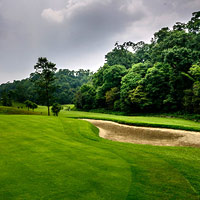
Gokarna Golf Club greens/ photo: hotel Kathmandu shopping is all about souvenirs. Lots of them. Mind you don’t buy any handicrafts over a century old – these are termed ‘antique’ and taking them out of Nepal is illegal. For anything remotely antique you’ll need a certificate from the Department of Archaeology in Kathmandu (near the Supreme Court). What else to buy? Even if you are not a fan of pashmina wool shawls (made from the fine inner fur of hardy Himalayan goats), that aunt of yours might appreciate something. If not a pashmina shawl or scarf, other local products include ‘thankas” (mystic scroll paintings), belts or wallets made from goatskin and water buffalo, ‘khukris’ (curved knives) used by the Gurkhas, woollen carpets, ceramics, ‘lokta’ paper, embroidered bags and purses, sarees of all description, teas and spices. If you’re clever at bartering, or a bully, give it a go. Whatever the way, Kathmandu shopping is entertainingly inexpensive. Durbar Marg and Thamel are the major spots for shopping in Kathmandu. On Durbar Marg you’ll find international clothing brands such as Benetton, Bossini, Giordano, Adidas and North Face. Most of these can be found along New Road, and if you’re still not satisfied, head over to Tripureshwar Road to the United World Trade Centre, one of the largest malls in the country. Don’t expect huge stores containing piles of Gucci or Louis Vuitton, although products such as Apple iPhones can be found if you look. Shoppers will be flummoxed by the amount of stuff on offer in Thamel from local handicrafts to woollen socks or hats, North Face sleeping bags, backpacks, ponchos, chess sets, books, embroidered shirts, jewellery, bags, and purses. This is also a great place to look for local instruments, as is nearby Khichapokhari. Other Kathmandu shopping hotspots are to be found in Patan’s or Kathmandu’s Durbar Squares (full of Nepali mementos and a great way to brush up on bargaining skills) and in the areas surrounding major tourist areas like Boudhanath. 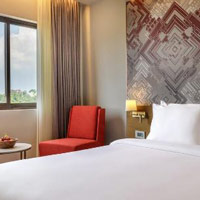
Cheerful Thai style at the new Dusit Princess Kathmandu / photo: hotel Or try the little lane right outside the Radisson Hotel in Lazimpat – it’s a peaceful place to browse if you need a break from the Thamel hoopla. In the stores here you’ll find the ubiquitous pashmina (prices start at around NRs1,000), embroidered cotton tops (from about NRs200), t-shirts, fleeces, jackets, embroidered bags and other bits and bobs. If you visit first thing in the morning, the shopkeepers may declare you a ‘lucky morning customer’ in which case you’ll get a good discount. Whether this is just a sneaky sales pitch, or a morning customer is indeed ‘lucky’, you’ll feel special nonetheless. Kathmandu hotels review, casinosWhere to rest your weary head after a day out sightseeing? There are options for every budget, from basic Kathmandu guesthouses to five-star hotels. The five-star offerings in Nepal might not have the gleam of an equivalent hotel in, say, Chiang Mai, but they are comfortable nonetheless and many are upgrading. It is common to find a casino tacked onto a hotel, albeit under separate management. Yes, Nepal casino hotels do exist unlike the yeti and you might spot some action ay Hyatt Regency, Yak & Yeti and the Radisson. Popular The Everest Hotel – that launched in 1981, went in for a big renovation in 2017 and is back again, spruced up somewhat but with many of its old features intact. Expect a large alfresco pool and a range of enticing stay deals from business to pilgrim packages. There are family rooms, a kids' pool, and a fitness room. With Covid receding, 2023 saw the arrival of fresh new faces to the hotel scene. Watch out for the Dusit Princess Kathmandu (www.dusit.com/dusitprincess-kathmandu/), a neat mid-range choice with tasteful Nepalese-Thai decor, a spa, and small meeting and banquet facilities for up to 250 people; and the suburban, upscale Dusit Thani Himalayan Resort Dhulikhel Nepal (www.dusit.com/dusitthani-himalayannepal/) an hour from the airport with grand views of the hills and access to several sites of Buddhist interest. 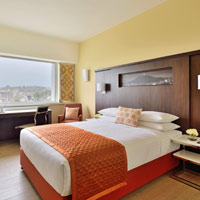
Bright room at Fairfield by Marriott/ photo: hotel Expect a Devarana Wellness spa retreat, yoga, sauna, infinity pool and alfresco jacuzzi. This could make a nice Nepal wedding resort with space for 300 in the Lumpini Ballroom. Or head up there for a corporate meeting in Kathmandu with a difference. Another younger hotel arrival is the Fairfield by Marriott Kathmandu, tucked in behind the now-abandoned Kaiser Mahal Palace on the edge of Thamel and a short walk away from the Garden of Dreams. Equally adaptable for business or leisure, it packs in 115 rooms together with a small fitness centre and a brace of meeting rooms. The ground-floor restaurant is open 24 hours a day and the staff fairly dazzle with enthusiasm and efficiency. A modern reflective glass Aloft (June 2019) is emerging next door. The five-star Radisson Hotel Kathmandu is in Lazimpat, neighbouring the Royal Palace. It is close to a number of diplomatic embassies (the British, Indian, French, Finnish, Israeli, Japanese, Chinese, Mexican, Russian Embassies and the Canadian Consulate are all within walking distance), as well as the central business district. Thus the Radisson is a popular choice for business travellers. This eight-storey hotel offers 260 rooms ranging from superior to premium, with some luxury suites. Rooms are clean and well presented, and include complimentary internet access, writing desk, satellite television, coffee maker, hairdryer and a small safe. 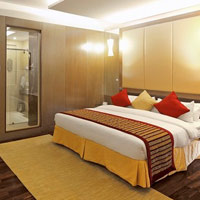
Radisson Premium room/ photo: hotel Pinstripers should check out the Radisson Business Class rooms, which offer additional amenities like complimentary breakfast, daily newspapers, free pressing of two garments, in-room snacks, and happy hour offerings at the lounge. The rooms are even equipped with personalised stationary. There are three restaurants, including the Terrace Garden for dining alfresco on the fourth floor of the hotel’s new wing. There are spacious meeting and conference facilities that can accommodate 800 people. The fitness club includes an outdoor pool with views over the city, as well as the usual weight and cardio machines, sauna and steam room. If you have a sweet tooth, check out the pastry shop for baked goods, homemade ice cream or just to grab a cappuccino. The lobby is often distractingly abustle. Fear not, staff is efficient and friendly. WiFi is available throughout the hotel. The Radisson is not just a good Kathmandu business hotel, it is close to the tourist spots of Durbar Marg and Thamel. And if gaming is your thing, a casino is on site. A cheaper alternative in the same area is Hotel Tibet. Step into the lobby and you might actually imagine, just for a minute, that you’ve got completely lost and ended up, well, in Tibet. You’ll be greeted by Tibetan-inspired detail from all sides. There’s hand-woven Tibetan carpets on the floor, Tibetan rugs draped over chairs, Tibetan furniture, and walls and mirrors bordered with Tibetan motifs. This hotel offers 56 rooms and suites with air-conditioning and satellite television. Dine at the Himalayan restaurant or kick back in the Yeti Rooftop Bar or Potala Garden Bar. 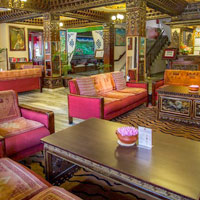
Hotel Tibet with its heavy local design and carvings/ photo: hotel There’s a 24-hour Internet lounge-cum-business centre for guests in need of a computer, and the hotel is WiFi-enabled. There are no in-room safes, but there is a safety deposit box at reception. The Shambala Spa offers Tibetan-style treatments and there is also a meditation room. Hotel Tibet is in a quiet street yet minutes away from Thamel. On the other side of the former Royal Palace is Hotel Yak & Yeti, a huge property, enveloped in history, on Durbar Marg, the main drag in Kathmandu. There are no yaks, nor yetis, but there are two main wings: one (containing The Chimney restaurant) is more than a century old, and re-emerges renovated in 2018. It was once the third palace of a prime minister of Nepal. The size of the building is vast, the grounds equally so. A sprawling garden contains two pools, tennis courts, a pond (with ducks), white chairs under white tents, jacaranda trees, large greens and a 100-year-old temple dedicated to the Goddess Kumari. The 270 rooms range from superior to suites and are either Newari in style (brick walls in red or white with intricate wooden carving) or more contemporary. Each comes with a writing desk and satellite television. Some of the larger suites are located on an exclusive floor, which holds a separate guest lounge. Conference and banquet facilities at the Yak & Yeti are spacious with chandeliers and a sense of history. WiFi is available and full secretarial services are offered at the business centre. 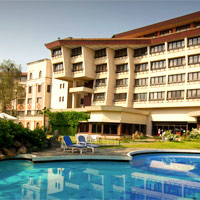
The Yak & Yeti is a five-star escape/ photo: hotel The main restaurant serves Russian cuisine and a mix of Asian and continental fare. There’s also a poolside bar and, for partying, the hotel has its own nightclub and casino. Yak & Yeti is one of the best Kathmandu business hotels – very competent with conferences – and is a fine pit-stop for leisure travellers too with a central location. Mark it in your diary. Also on Durbar Marg is the laid back but competent Hotel Annapurna (trimmed down from the slightly twee Hotel de l’Annapurna). The hotel has renovated in fits and starts over the years and its swimming pool has separate areas for adults and kids. The lobby is bright with souvenir shops greeting guests before the reception. It’s a large property sitting on five-and-a-half acres. The 155 rooms range from superior to suites and offer complimentary WiFi, TV, hairdryer, iron and ironing board and coffee maker. Our pick would be the Corporate Deluxe with soundproofed windows, flat-screen television, laminated wooden floors, a wood-panel head wall, and a cosy ambience with textured floor rugs. This is the most toned down version of the rooms and offers a contemporary vibe. There are three restaurants, one bar and a cake shop. For health buffs, there’s the aforementioned pool (one of the bigger hotel pools in Kathmandu) and fitness club. The hotel offers large conference and meeting facilities and can provide themed receptions on its lawn. There is a baby-sitting service and, as seems to be the norm for larger hotels in Kathmandu, a casino. Kathmandu’s Shangri-la Hotel (no relative of the Hong Kong headquartered regional chain) is set in lovely grounds in Lazimpat where guests can while away the hours sitting in delightful gardens, listen to the birds and sip a great brew. The lobby is elegant, Indo-Tibetan in style, with an old piano sitting beside the entrance. 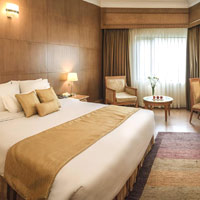
Hotel Annapurna Corporate Deluxe room / photo: hotel Some of the 95 rooms are decorated in traditional Newari style while others sport contemporary decor. For a tad more comfort, the top floor offers larger rooms including two deluxe suites, a club lounge and views across the gardens. Internet access is available in rooms and there is complimentary WiFi available in the hotel’s coffee shop. There are meeting and conference facilities and bookworms will welcome the reading room. A fire roars in the Lost Horizon Bar on cool Kathmandu nights and Saffron Restaurant serves up Indian cuisine. The Shangri-La’s hair salon and spa, located on the street outside of the hotel, are popular, so book in advance for a makeover. Himalayan legend Sir Edmund Hillary stayed here, as did explorer Dame Freya Stark. If it’s good enough for them… South of the former Royal Palace, near Patan, is Hotel Himalaya. It is close to the United Nations complex, as well as the Norwegian and Egyptian embassies. It claims it is the only hotel in the city to have 180 degree views of the Himalayas. It’s termed five-star, but this 125-room hotel has seen better days. The property switched from Japanese to Nepalese ownership some years ago. Standard rooms have been slowly and systematically renovated and come with wooden floors, Newari décor and a new bathroom. All rooms come with LCD TVs, Internet, international dialling, hairdryer, and in-room safes. There’s also a floor full of Executive rooms, which boast their own enclosed balconies (some with great views over the city). The hotel offers spacious grounds, a pool, tennis court, meeting facilities, its own temple, two bars and a restaurant. The ancient Patan Durbur Square is a 15-minute walk away. Hyatt Regency Kathmandu is a livelier pick on the Kathmandu block. It’s all about space at the Hyatt. Set on 37 expansive acres, its rooms are among the biggest in the city, and it has more of them (280) than any other Kathmandu hotel. 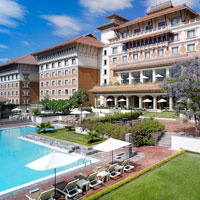
Hyatt Regency/ photo: hotel The Hyatt has a gloss to it that is conspicuous by its absence elsewhere. A long driveway is bordered by grassy gardens and meanders up to the hotel’s entrance. The lobby is large and light-filled. There is a sunken ‘temple court’ holding replicas of Buddhist temples, where guests can sit on cushioned seats. The garden holds two pools, vast lawns, tennis courts and a view of Boudhnath Stupa. Rooms are cheery but on the plain side with wooden floors, king-size beds, WiFi, TV, hairdryer, bathrobes, and granite bathrooms with separate bath and shower. Book the presidential suite and you’ll get an entire floor, a bathroom with rain shower, a Jacuzzi that looks out to Boudhanath, and separate kitchen and dining area. There’s a slick spa and fitness centre. Four restaurants cover all tastes from casual poolside to formal dining. Extensive conference facilities complete the picture with 950sq m for a decent MICE event, wedding, or corporate chinwags. Grab a ‘Chaitya Walk’ map from the lobby and explore 1,500 years of Buddhist architecture, all located a short walk from the hotel. Swing kings will also find four golf courses in the country, two of which are in the Kathmandu Valley. Indeed, golfing in Nepal is on the upswing, led by top-ranked teenage golf sensation Pratima Sherpa. If your preferred mode of transport is by helicopter, and your wallet is up to it, there’s a helipad in the garden. A great escape for work or personal refuge, this is one of the top hotels in Kathmandu for small corporate meetings, business, or a lazy stretch. 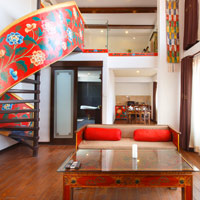
Dalai-La boutique hotel penthouse/ photo: hotel If you fancy Thamel, but need peace at the same time, try the Kantipur Temple House. Built in 1998, in the style of a typical Newari temple, Kantipur Temple House offers 48 rooms furnished with traditional art and décor. The open rooftop terrace offers views of the city, the hills and Swayambhunath stupa. There are two restaurants, a courtyard and garden. Kantipur Temple House waves an eco-friendly banner – there’s no use of plastic bags, guests are provided with cloth shopping bags, the hotel does not sell plastic bottled water (free water is offered in jars), and organic vegetables are used in the restaurants. Even the water is solar-heated, and televisions are banned unless required for presentations. There is no air-conditioning in the rooms but the hotel provides fans in summer and electric blankets in winter. Free WiFi is available in the lobby and common areas. Kantipur also offers wellness activities such as outdoor yoga classes. It is a sister company to Bhojan Griha, an excellent Nepali restaurant in Dilli Plaza (more on that later). Also in Thamel, and setting a superb example to the area’s hoteliers, the 32-room Dalai-La incorporated the owners’ original home to which a new wing was added. Set around a courtyard (the main dining area) this cleverly imagined red-brick boutique hotel is embellished with attractive design elements such as prayer wheels set into the walls. Rooms are attractive with wooden floors, a minimalist feel and red lacquer touches, There’s also a very smart spa, and a yoga and meditation room, while both an astrologer and palmist are on call. Who needs a concierge? 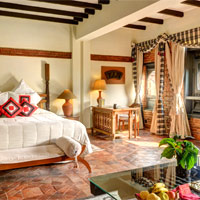
Dwarika's Suite and homey decor/ photo: hotel The museum-like Dwarika’s Hotel is about ten minutes’ drive from the centre of town, in a residential area called Battisputali. It’s within walking distance from Pashupathinath. The hotel is built in the Newari manner with intricately carved wood and brick and throughout are rare antiques and artefacts collected over many years by the late Dwarika Das Shrestha, whose aim it was to preserve the heritage of Nepal. The 87 rooms are each individually designed – some have 16th century windows, others have private courtyards. All are WiFi-enabled. Hand-painted fabrics are used for the bedspreads and curtains, linen is handwoven and some of the artwork dates as far back as the 14th century. There is a separate bar and three restaurants, one offering a 22-course menu. For relaxation, try the in-room massages or head straight to Pancha Kosha Spa, which also offers daily yoga classes. You can also grab a book in the library, browse the Internet at the business centre, or park yourself in a lounger beside the pool. For a real treat, try the Royal Suite, which covers three floors with its own formal and informal meeting areas in addition to the bedroom, bathroom and private lounge area. Also consider a short one-hour drive up to Dhulikhel where Dwarika's has a second resort style property with grand views of the Himalaya. Soaltee Crowne Plaza is west of the Royal Palace in Tahachal, a ten-minute drive from central Kathmandu. Set on 11 acres, this five-star hotel has 282 rooms, including 16 ‘Regal’ suites. All rooms have complimentary daily newspapers, TVs and VCRs, as well as WiFi. A stay in one of the Executive Club rooms comes with free daily breakfast and evening cocktails at the Club lounge. Elite club members are eligible for free standard Internet access. 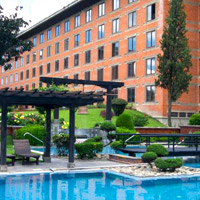
Soaltee Crowne Plaza/ photo: hotel The inside of the lobby is bright and brisk. Soaltee Crowne Plaza (once the Soaltee Oberoi) has ample facilities for conferences and meetings and remains among the more popular Kathmandu business hotels. There are four restaurants and two bars (including the club lounge). A pool and gym will satisfy health nuts and the tennis court comes complete with ball boys. A casino is also on site. About five minutes away by foot is the Kalimati Fruit and Vegetable Market – the biggest fruit and veggie market in the valley. Dive in and find your dream asparagus. If you’re in need of a Kathmandu casino hotel, look no farther. Want to hit the golf greens in Kathmandu? Then consider staying at Gokarna Forest Resort (previously managed by Le Méridien), about 30 minutes from the city centre. Gokarna might be farther afield, but this three-storey resort offers forest surrounds (once the private hunting grounds of the Nepalese kings), panoramic views of the Himalayas, and a Gleneagles-designed 18-hole golf course run by the Gokarna Golf Club on its doorstep. The driving range charge for non members is NRs300 with a bucket of 50 balls for NRs200. All of the 55 wooden-floored rooms and suites have views of the forest. The hotel has an indoor pool and spa, overlooking the valley. The spa services are well regarded and worth a try with a 60-minute massage from NRs3,600 (about US$35). Wine and dine in one of four bars and restaurants – for fine dining and a taste of history, try Hunter’s Lodge Restaurant, previously a royal hunting pavilion. 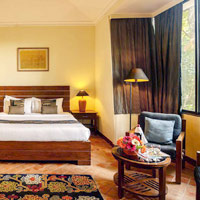
Gokarna Forest Resort Room/ photo: hotel Look out for deer and monkeys that wander free nearby. The resort can organize horse riding and mountain biking adventures, and forest walks and secluded picnics. Club Himalaya Nagarkot sits atop the aptly-named Windy Hills. It is certainly windy up here in Nagarkot to the east of the city, past Dhulikhel, and markedly cooler than the city. The hotel advises guests to always bring a windcheater and “avoid loose flying skirts and sarees unless you want a Marilyne [sic] Monroe experience”. From outside the hotel on a clear day there are dramatic views in every direction. Club Himalaya is one of the bigger places to stay in Nagarkot, with five floors and 52 standard rooms offering basic amenities and private balconies. Deluxe rooms dating to 2011 feature hardwood floors and use minimalist Buddhist elements to create a Zen-like feel (despite the WiFi and LCD televisions). Furniture is predominantly handcrafted locally. Private balconies have views of the mountains. The lobby, which contains one of the hotel’s two restaurants, has a dark wood interior, making things a bit dim on cloudy days. There are views from certain parts of the lobby, but these are partly obscured by foliage. From the lobby restaurant, peer over a waist-high wall at people swimming in the indoor pool and spa below. It is hikers’ heaven up here and Club Himalaya can arrange a car for day or overnight trips. Other outdoor activities include pony rides, kite flying, a children’s park, and a jogging track. Those less outdoorsy can unwind by catching a film at the on-site movie theatre. Despite, or maybe because of its location at 7,200ft, the hotel boasts its own helipad so that visitors can quite literally ‘drop in’. The drive from Kathmandu to Nagarkot is about an hour and a half but two hours may be a better estimate with the traffic. Budget hotels and guesthouses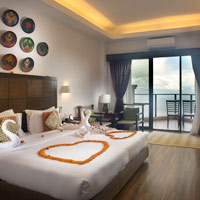
Club Himalaya, smart room with views, Nagarkot/ photo: hotel For Kathmandu budget hotels and cheaper rates, head to Thamel. Cheap and cheerful are the likes of Hotel Manang, Hotel Impala, Hotel Marshyangdi, Hotel Northfield, Kathmandu Guest House (which celebrates its 50th anniversary in 2018), Hotel Potala Kathmandu, and the earlier mentioned Hotel Tibet with its heavy Tibetan decor, sofas and detailed wood carvings along the roof beams and lintels. There's also the Tibet Guesthouse. Accommodation at Kathmandu guest houses is variable, rates change constantly and, if you go for the cheapest rooms, bathrooms will be shared. However, weary trekkers returning from the mountains report that Thamel guesthouses are luxury digs indeed. The Regal Airport Hotel (again no cousin of the Hong Kong Regal chain) had January 2018 off season rates at US$25. What you see may not be what you get. So look closely. Do note that the government has introduced various home-stay programmes to allow visitors to see how the locals live, and AirBnB is flourishing. For more information, check out www.visitnepal.com. There are also volunteering placements available across Nepal, mostly involving teaching and mentoring orphaned children (see www.volunteernepal.com or www.mountainvolunteer.org). Dining and Newari style to pizzaFor those lacking a cast-iron stomach, steer clear of uncooked food in Nepal (including cut fruit). Avoid ice, and drink bottled mineral water. If you’re after McDonalds, then you’re out of luck, for now, however KFC and Pizza Hut are open. Progress. Local Nepalese food is cheap, tasty and involves plenty of lentils. Nepalese curries are light and not overly spicy. Momos are steamed dumplings filled with meat or vegetables; a Nepal trip is not complete without sampling these delicious morsels. 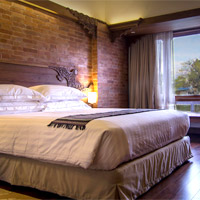
Yak & Yeti style/ photo: hotel For good, organic, Nepalese food, try Bhojan Griha in Kathmandu’s Dilli Bazaar (tel: [977-1] 441-6423, www.bhojangriha.com). Bharat Basnet is the genteel and hospitable man behind restoration of the 150-year-old building where the restaurant is housed. The place is full of character and reminiscent of the French colonial yellow buildings in Hanoi with green windows and doors. Stairs lead up to the dining entrance where shoes are left at the door, hands are washed in the traditional manner and foreheads dotted with a ‘tilak’. Three dining floors are set up with the customary low chairs, low tables and heavy brass tableware. Dinner begins with a shot of whiskey (called “thon”) and, intriguingly, popcorn. Dishes arrive in rapid succession. These may include “aloo tareko” (spiced potatoes), momos, “jhaneko mas ko dal” (lentils), and “khashi ko masu” (lamb curry). It’s all topped off with a sweet yoghurt dessert. Eating is accompanied by bursts of Nepali music and dance. The set menu costs US$20 plus tax per person. Drinks are extra. Reserve a table – this place is popular. Bhojan Griha is not the only string to Basnet’s eco-friendly bow. He also manages wildlife lodges in other parts of Nepal, was the leading force in changing Kathmandu’s tempos from diesel to battery-power, and is working to reduce the use of plastic wrappers in Kathmandu. Newer arrivals include Le Sherpa (tel: [977] 980-115-9480) serving French) fare in a pretty garden. A farmer’s market on Saturdays makes this a popular expat spot. There are dozens of other dining spots in Thamel and Durbar Marg where you can get anything from Japanese to German, Chinese to Mexican, Italian to vegetarian. The more expensive restaurants are located on Durbar Marg and a few local fast food chains are dotted around town; The Nanglo chain (tel: [977-1] 554-4263, www.nanglo.com.np) comprises Nanglo Café & Pub, the Nanglo Chinese Room, Nanglo Deli and several Bakery Cafes throughout Kathmandu. Food is cheap and ranges from Chinese and western, to Indian and Nepalese curry. Interestingly, the chain has been training and employing hearing impaired persons since 1997. 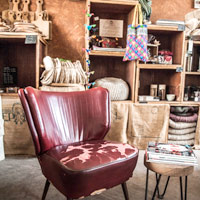
kar.ma coffee shop/ photo: shop A sudden craze for coffee has seen new bars popping up all over Kathmandu. One of the smartest kar.ma (tel: 984-376-7232 or 980-843-4979; Facebook: karmacoffeenp) in Patan sources all its Arabica beans directly from small cooperatives around Nepal. Every stage of the coffee production, from the farming to the sorting to the roasting, grinding and packaging is done by hand and gives employment to local people. Essentially, it’s social sipping – in a very neatly designed space. It is worth dropping by this coffee boutique run since 2012 by an Austrian who visited Nepal and never left. Other food joints include Fire and Ice for pizza and pasta (www.fireandicepizzeria.com). There’s a huge variety of eating and drinking options in the Thamel area. These change change hands and names frequently. Look out for Utse Restaurant, Yak Restaurant, The Rum Doodle (a favourite with mountaineers, perhaps not for the food, and visited by Edmund Hillary), La Dolce Vita, Brezel Bakery and countless others. And that’s a quick A-to-Z Kathmandu fun guide. Amidst the mayhem, there’s a mystic experience to be had. And lots of momos. Eat up, people. Send us your Feedback / Letter to the Editor FAST FACTS / Hotel Contact List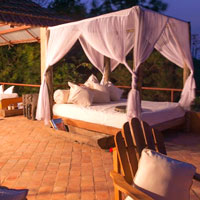
Dwarika's Dhulikhel/ photo: hotel Exchange rate: The Nepalese currency is the Nepalese Rupee (US$1=NRs131). There is a foreign exchange counter at Tribhuvan International Airport. Banks, moneychangers and ATMs are available in the city. Hotels will change US dollars and other major currencies at their own conversion rate and major credit cards are accepted. Travel season: Nepal has four seasons. Winter is from December to February. It gets cold in the city but doesn’t snow. There is snow on the hilly surrounds though. Spring is from March to May and is a good time to visit, although it starts to get hot and dusty towards the end of May. Summer, from June to August, is rainy season. Autumn is from September to November. This is peak season, when the air is clear, and the temperature moderate. Travel Agencies and Information: Some online travel resources could include the Nepal Tourism Board (www.welcomenepal.com), Nepal Association of Travel and Tour Operators, and Nepal Association of Tour Operators (nepaltouroperators.org.np). Brief Kathmandu hotel directoryAll hotel prices are subject to 13 percent VAT (value-added tax) and 10 percent service charge. In many cases steep discounts will be available especially at off-peak times. Any rates quoted here are for rule of thumb only. Always check for the best available rates (BAR) online. As a general guide room rates may range from US$25 for a guesthouse or US$65 for a simple hotel to US$140 at a local five-star or US$200 (for a suite in high season) at an international five-star hotel. Club Himalaya Nagarkot. Tel: [977-1] 668-0080, 668-0083, 668-0048, (hwww.clubhimalaya.com). Budget hotels and guest housesKathmandu budget hotels and guesthouses vary vastly in quality and amenities. For the very cheapest rooms, bathrooms and/or rooms will be shared. Clarify these details before booking. Hotel Impala. Tel: [977-1] 470-1549, (www.hotelimpala.com.np).
NOTE: Telephone and fax numbers, e-mails, website addresses, rates and other details may change or get dated. Please check with your dealer/agent/service-provider or directly with the parties concerned. SmartTravel Asia accepts no responsibility for any inadvertent inaccuracies in this article. Links to websites are provided for the viewer's convenience. SmartTravel Asia accepts no responsibility for content on linked websites or any viruses or malicious programs that may reside therein. Linked website content is neither vetted nor endorsed by SmartTravelAsia. Please read our Terms & Conditions. |