FAMILY FUN
A stroll through Hong Kong's
beautiful Wild Wild East
Secret walks, bites and stories along the historic New Territories Hakka heritage frontier from Luk Keng to Fung Hang, Kuk Po and Lai Chi Wo. Several abandoned villages are fading as the last few residents battle falling beams, termites, and bovine herds.
Written and photographed by Vijay Verghese
April 2026
SEE ALSO Hong Kong shopping guide | Hong Kong Business Hotels | HK Causeway Bay and Haven Street Fun | Sanya Guide | Macau Guide | HK Yuen Long Coffee and Cafe Guide | Singapore Green Hotels Review| Songdo, Incheon | HK Museum Tour
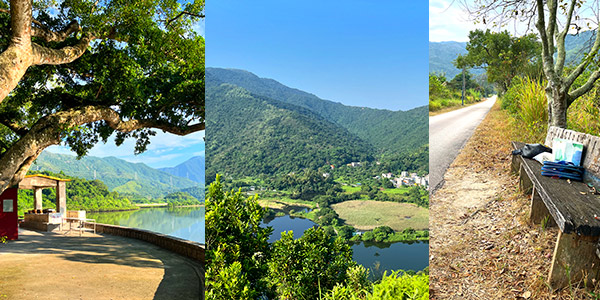
Idyllic Guanyin shrine (left) faces Starling Inlet near Nam Chung Village; Nam Chung Valley flanked by green hills (centre) is a journey back in time along a narrow single lane that leads on to the entrance to the country park trail/ photos: Vijay Verghese
FROM the wind-whipped eyrie of Robin’s Nest in the far Northeast of Hong Kong’s New Territories, you can see the relentlessly rising contours of Shenzhen to the north as well as the curious border town of Sha Tau Kok to the south that was once a bustling centre of border commerce. Its Chung Ying Street was where culture, shopping and smuggling collided in a heady blur of activity. Sha Tau Kok was closed to the public for many years but partially reopened in 2022. Visiting the place requires a Tourism Closed Area Permit that is free of charge and takes two days to process. The simplest way to get there is to catch bus 78K from Sheng Shui or Fanling Stations.
SUBSCRIBE FREE TO SMART TRAVEL ASIA NEWSLETTER
Facing south, you will also make out the single-lane Luk Keng Road that winds down along scenic Starling Inlet to Bride’s Pool Road and on to Plover Cover near the water sports zone of Tai Mei Tuk. Green minibus 56K from Fanling services this route. It turns south before the border to follow the bay along narrow Luk Keng Road, passing egret sanctuaries and a picturesque Guanyin shrine, from where a tiny lane branches off into the valley leading past Nam Chung Village and its former duck ponds, to Nam Chung Country Trail and the Ping Nam stream's waterfalls and rock pools.
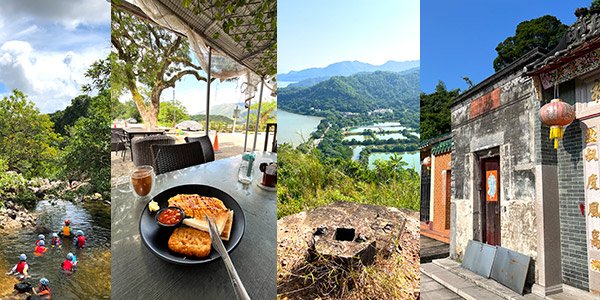
The Ping Nam River (left) is crossed on the walk up Nam Chung Country Trail; Fat Kee Store (left centre) is the starting point for the Kuk Po walk and serves hearty breakfasts; Atop a Japanese wartime machine gun pillbox looking down over Luk Keng ponds and abandoned hamlets (Centre and right)/ photos: Vijay Verghese
The minibus route ends on the road near the largely abandoned Luk Keng Village where an array of plastic chairs offer testament to this little unsung outpost. From here a paved lane heads into the village passing the BB Happy Store (one of the few cafes serving this area) run by the ebullient and tough Annie who keeps a sharp eye on the competition. Prices are steep the food indifferent but then this is a frontier. Several celebrities have graced the place and Annie points them out in a room that has fading photos packed wall-to-wall.
The small lane plods into this hamlet linking three clusters of homes, mostly derelict with mail hanging off the doors in roped bunches like overripe fruit. The town is arrayed around a vast marsh and during the rains much of it is prone to flooding. Some homes have been repainted recalling their past glory while others with blackened walls have been overwhelmed by vines and flowering creepers. There is a desolate beauty to it all but it is clear the place is disappearing fast. A path cuts on from here past the public toilet through creaking bamboo fronds, climbing up the hills to link with the Wilson Trail (Section 10). You can loop back into the Nam Chung Valley from here or head farther up into the Pat Sin Leng range.
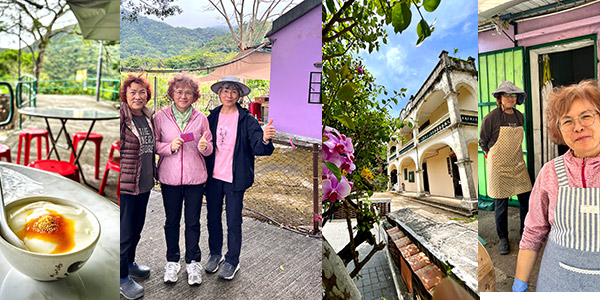
Uncle Sung Tofu is run weekends by sisters (centre left, from left)) Hang, Billie and Ching; The Kuk Po School, now closed is right behind the lavender store (centre right); And Billie, (foreground far right) explains how in the old days her father rowed to Sha Tau Kok to buy supplies/ photos: Vijay Verghese
About 5-10 minutes into this walk where the trail branches left towards the Wilson Trail, a right fork zigzags up a low hill for a sweaty 20-minute hike up to the site of a few large concrete machine gun pillboxes. This was a defensive position used by the Japanese (1943-1945) to counter local resistance and attacks by the East River Column, a guerilla outfit run by Chinese Communists in tandem with local insurgents tasked with spiriting out intellectuals and rescuing downed Allied pilots. The path is constantly closed for maintenance but if you hazard the steps watch the overgrowth that hides potholes and deep trenches that can cause serious injury. Use a hiking stick to regularly test the path. Once up, the view opens up across the bay to Shenzhen and down to the wetlands. Alas, the bunkers underfoot are not easy to access.
From the 56K minibus stop it’s a short five minute walk up Bride’s Pool Road past a small public carpark to the delightfully ramshackle Fat Kee Store (with alfresco spaces) that has been in operation in various forms since around 1960. It is now a laid back pit stop on the waterfront trail leading to Kuk Po. It is a weekend gathering ground for bikers, hikers and birdwatchers. Stop here for a hearty breakfast — perhaps cheese omelette or fried eggs with sweet potato, sausages, toast and baked beans, with milk tea — saving a few nibbles for the ageing mastiffs before striking out along the shore walk. The food and friendly service here is a tad better than at other spots.
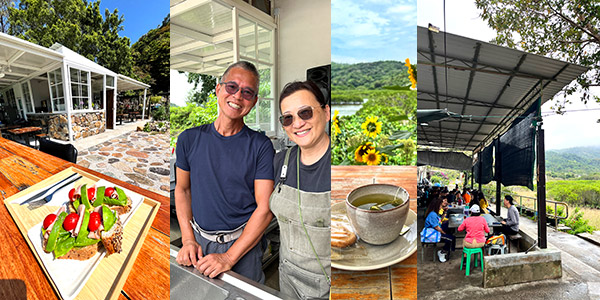
Kuk Po was once a bustling hub that connected hillside Hakka villages to the Shau Tau Kok border trading post. The breezy Mediterranean Kuk Po Cafe (left and centre) is run by the cheerful Yangs. In summer spot sunflowers; Chung Kee Store (far right) is popular for its Hakka cuisine on weekends/ photos: Vijay Verghese
The concrete path follows the coast looking at Sha Tau Kok and Shenzhen across Starling Inlet. Within a few minutes the trail veers left (away from the family walk) leading up 125 shallow steps, across a wooded knoll and quickly down again to a small cove housing the abandoned village of Fung Hang Tsuen. On some weekends a few residents muster up the area’s speciality radish cake for sale to hikers, the offers broadcast on small loudspeakers that churn out festive music.
Moving along you’ll pass a mangrove coast and a section of orange rocks that slope into the sea. This is where some like to dip their feet in the clear water, fish, or search for crabs. A 30-minute stroll will bring you to Kuk Po and some cheery red chairs under stretched tarpaulin next to a lavender cottage. This is an old tofu fa (tofu with sweet orange cane sugar) spot run by the lively Sung sisters, Billie, Ching and Hang and their brother, who took over the family business (Uncle Sung Tofu) as a weekend hobby Saturdays and Sundays. They bring in their supplies by boat from Sha Tau Kok.
Next to their spot is the old school, now abandoned save for a room with displays of the local history. This is where many of the remaining villagers once studied. Billie points up the path to her old redbrick Hakka home. No one lives there now but it presents a pretty sight when I pass by, the Chinese inscriptions along the parapet blessing descendants with the joys of prosperity and prestige. “You know, my father, ‘Uncle Sung’ used to row his boat all the way across to Sha Tau Kok to collect supplies,” says Billie. “He ran a store for the schoolkids from our home.” Later it became a store by the seafront, the tarpaulin was stretched out, and homemade tofu fa was added by the sisters to the simple inventory. Billie looks wistfully into the distance and smiles: “It is a pleasure to return every weekend.
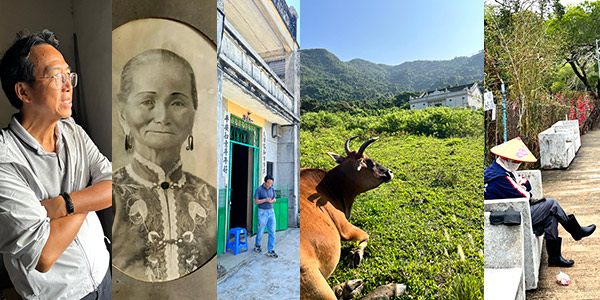
Colin Yeung (far left and centre) returns every weekend when he can to work on the family home, heavily infested with termites, while his great grandmother's photo calmy surveys the scene; Cow suns itself in front of the sole rennovated Hakka home (centre right); and Hakka lady takes a break near Fung Hang / photos: Vijay Verghese
Straight on along the waterfront is tiny Kuk Po Village where on weekends under shade trees and in the Chung Kee Store veranda you’ll spot several tables serving Hakka fare. This offers an interesting insight into the local culture and food. While weekdays are completely devoid of activity and the tables and chairs are neatly stored away, weekends are lively in this forgotten corner and chatter fills the air as joggers and hikers trickle past.
Facing the inner marsh is Kuk Po Café, the contemporary, and very Mediterranean virginal white glass-and-stone bolthole run by the Yangs. In summers the area is ablaze in sunflowers. Amidst nature sounds, birdcalls, and romantic music, sample assorted teas, light bites, bruschetta, and Taiwanese beef noodle soup. Beaming Mrs Yang is from Taiwan. They make cheerful hosts and look forward to pampering the few customers weekends when they have a chance to pluck herbal delicacies from their own vegetable patch. Typhoon Ragasa flooded the entire area in September 2025 but the place was painstakingly restored. Mrs Yang worked a while in Japan and later moved to Shenzhen with a Japanese company to handle translation. It was there that she met her restaurateur husband 30 years ago. Later, the couple moved to Kuk Po where Mr Yang’s family lived.
From here a semicircular path skirts the wetlands touching inner hamlets and homes as it circles back to the Sung sisters, the school, and the seafront. Along the way I run into the affable Colin Yeung who is returning to check on his ancestral home. It is now a tad rundown and in the process of being devoured by termites. He points to the stairs that have been hollowed out and rendered unusable. He is helpless. Attempts to rejuvenate the area with official subvention have failed and the children are not tied to the land.
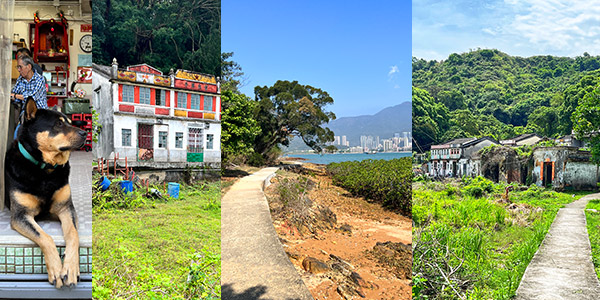
From Fat Kee Store at Luk Keng (far left) where lazy mastiffs await loose morsels, the paved walk to Kuk Po takes about 40 minutes passing the abandoned village of Fung Hang (far right) with views of Shenzhen across the inlet; (Centre left) the red painted family home of the Sung family/ photos: Vijay Verghese
This visit is a weekly ritual of reconnection. Adjoining is his uncle’s home and the stairs are sufficiently strong for us to climb up and take in the view across the marshes and sleeping cows that wander the paths foraging for the best grasses. Back at his father’s place an old black-and-white photo of his great grandmother, a striking gentlewoman in a high collar cheongsam and dangling earrings, looks across the room.
Colin’s grandfather and granduncle worked as deckhands on ships that sailed to South America and it is there that they earned the money to construct these homes, once grand residences that echoed with voices and talk of far-off lands. “As kids we used to play hide-and-seek along the ridges and slept under mosquito nets,” he says matter-of-factly. Like his great grandmother, he appears resigned and calm. “I am an engineer and quite practical,” he explains with a wry smile.
He is also planting a lime tree in a small overgrown patch that he hopes to clear over time, a far from practical task. “I have to protect it from the cows,” he chuckles. “No one owns them now. Their original owners must have migrated and the cows wander everywhere.” The bovine bunch are much in evidence around Kuk Po wallowing in the marshes, munching on flowerbeds, and occasionally blocking the narrow path. “At one time someone sold a few for a good price in Sha Tau Kok,” Colin says, laughing at the recollection. That was a time when all the villagers from the hills came down to the Kuk Po pier to cross over to Sha Tau Kok to trade. It would have been a bustling place. “We just need a bigger pier to revive Kuk Po,” Colin muses. He may be right. Ferry access from Sha Tau Kok and Luk Keng would be a real shot in the arm for those unable or unwilling to endure a normally pleasant 40-minute walk from the Luk Keng minibus stop. While winter walks are bracing, in summer the heat and humidity can be stifling. A ferry service could continue on to connect other forgotten villages along the coast.
I thank Colin for the personal tour and set off again. An hour-and-a-half’s climb up and then down through Plover Cove Country Park plodding east from here along a trail — or a longer three-and-a-half-hour circuitous route along a worn path that rounds the promontory — is the 300-year-old walled Hakka village of Lai Chi Wo with its grey slate roofs set in neat terraces facing the fields and mangroves. It was a lively spot in its heyday but largely abandoned now though it has UNESCO heritage recognition and is undergoing a modest revival with private funds pushing sustainable farming and ecotourism. On my last few visits some activity had returned. Today is a music festival to commemorate the harvest — quite a trek for the bold hearted — but I decide it is too late in the day, wave at the silver-haired Sung sisters and commence my stroll through the crisp spring air back to Luk Keng.
Send us your Feedback / Letter to the Editor
▲ top